
Soccer’s law-making body, the International Football Association Board (IFAB), has clarified its guidance to referees regarding the application of the “mistaken identity” rule, confirming that Switzerland forward Breel Embolo should not have been sent off during his nation’s World Cup quarter-final match against Argentina.
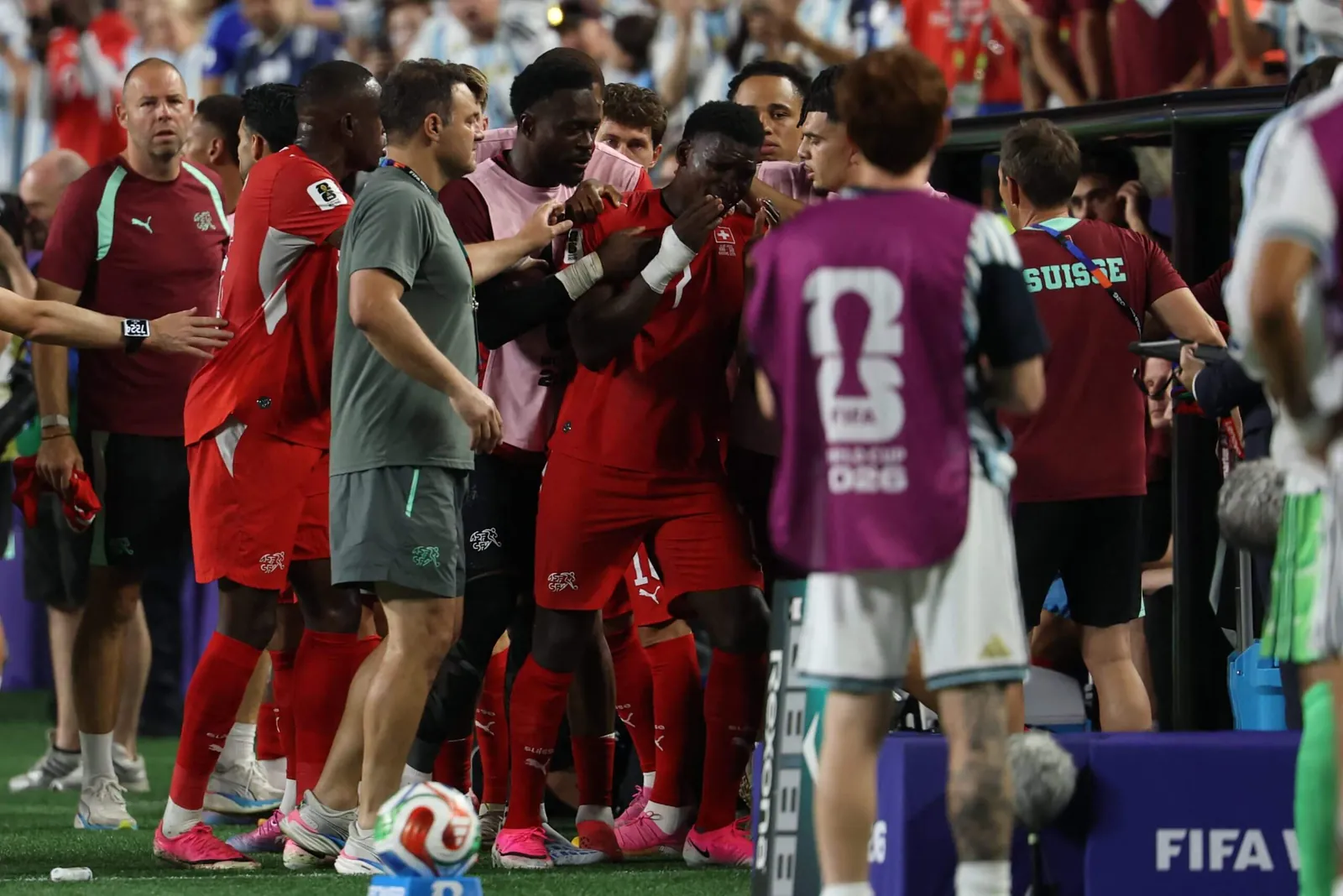
The incident occurred in the 72nd minute of the game, shortly after Switzerland had equalized to make the score 1-1. Embolo received a second yellow card, leading to his expulsion, after a video review for simulating a foul. Argentina ultimately won the match 3-1 in extra time.
VAR protocol clarification
The IFAB issued a clarification stating that the Video Assistant Referee (VAR) protocol for “mistaken identity” cases was not applicable to the type of incident involving Embolo at the World Cup. This guidance means that while the use of the mistaken identity clause to address simulation during the World Cup was generally well received, it cannot be formally used in this manner until a review of the VAR protocol is concluded.
According to the IFAB, a yellow card, if it is not a second yellow card, can only be reviewed to identify the player who committed the penalized offence. The offence itself cannot be reviewed or changed. This means that if a referee initially penalizes a foul, VAR can only intervene to correct if the wrong player was identified for that foul, not to change the nature of the offence to simulation.
The incident involving Embolo began when he fell to the ground after a challenge from Argentina midfielder Leandro Paredes, who was initially shown a yellow card. VAR officials then alerted the referee that Paredes had not committed a foul, leading to Embolo receiving a second yellow card for simulation and being sent off. The yellow card for Paredes was subsequently overturned.
This application of the rule was similar to an earlier incident in the tournament during the United States‘ group-stage victory over Paraguay. In that match, Tim Ream was initially booked for what was perceived as a trip on Paraguay attacker Miguel Almiron. VAR recommended a review for “mistaken identity,” and the decision was reversed, with Almiron instead booked for simulation.
Switzerland coach Murat Yakin expressed his frustration after the game, stating that the referee’s decision was incorrect and that the rule had significantly impacted his team’s performance. He noted that the team had momentum after the equalizer and intended to make substitutions to bring on fresh attacking players.
Ongoing review and future implications
A review of the VAR protocol has been in progress since March, and incidents like Embolo’s are part of this ongoing assessment. The IFAB, which includes FIFA-appointed officials and the four British soccer federations, holds annual meetings to update the Laws of the Game, with changes typically taking effect for major tournaments or the subsequent season.
UEFA praised the IFAB’s clarifications as “welcome explanations,” emphasizing that VAR is not intended to re-referee matches. UEFA stressed the importance of shorter video reviews and a lighter touch for interventions, setting a standard for VAR intervention when a referee’s decision is “blatantly incorrect” or when a clear incident has been missed.
The organization also supported the crackdown on time-wasting, a measure agreed upon by the IFAB in March and enforced by FIFA during the World Cup. UEFA plans to instruct referees to strictly and consistently enforce these new rules in upcoming men’s and women’s club competitions, including the Champions League, as well as national-team games in the men’s Nations League and qualifying matches for the 2028 European Championship and the 2027 Women’s World Cup qualifying playoffs.
The IFAB’s circular on Monday aimed to clarify that the original offence should not be overturned, as it was in the cases of Almiron and Embolo receiving yellow cards for simulation. The rule is intended only for situations where the incorrect player was penalized based on the on-field official’s initial judgment.
The confusion surrounding the application of the “mistaken identity” rule suggests that while the intention was to improve fairness, its implementation led to unforeseen consequences. The IFAB’s update aims to ensure that this rule is not interpreted in the same way again, though the full review of the VAR protocol is still pending.
The IFAB’s annual meeting in February or March will address further updates to the Laws of the Game.
Source: sportsnet.ca